llms.txt, Explained: How to Make Your Website Readable to AI Agents (With Our Exact Template)
AI agents now generate several times more network traffic than humans on many business sites. llms.txt is the emerging standard that points them to clean, structured summaries of your key content. Here is how we implement it, with a copy-paste template.

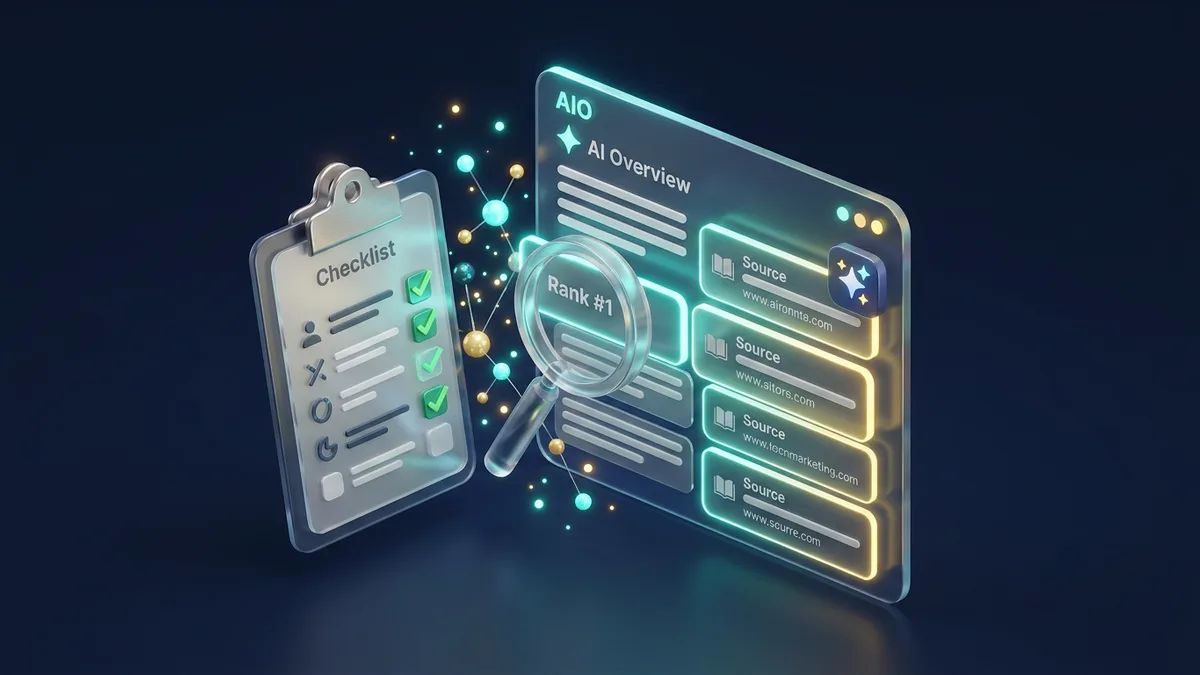
Quick answer: llms.txt is a plain-Markdown file at your site root (like robots.txt, but for guidance rather than blocking) that gives AI agents and crawlers a curated map of your most important content. Its companion, llms-full.txt, includes fuller content summaries. It cannot force any AI to do anything — but as agent traffic explodes (AI agents generate several times more network traffic than human visitors on many business sites, with agentic-browser traffic up thousands of percent year over year), giving machines a clean, unambiguous summary of who you are and what you offer is cheap insurance with real upside.
What llms.txt actually is (and is not)
- It is: a Markdown file listing your key pages with one-line descriptions, so an LLM landing on your site can orient instantly without parsing your entire DOM.
- It is not: an access-control mechanism. robots.txt blocks; llms.txt guides. They are complementary.
- Adoption status: emerging standard — not officially consumed by every engine, but increasingly read by AI dev tools, agent frameworks and several answer engines, and it costs 30 minutes to implement.
Our template (copy and adapt)
# Your Company Name
> One-sentence description of what you do, for whom, since when.

Key facts: founded year, locations, team size, core services, contact.

## Services
- [Service Name](https://yoursite.com/services/x): one-line description with the outcome it delivers
- ...

## Proof
- [Case Studies](https://yoursite.com/case-studies): representative results with numbers

## Content
- [Blog](https://yoursite.com/blog): what topics you cover

## Contact
- Email, WhatsApp, booking link — the actions you want an agent to surface
Five implementation rules that matter
- Facts over adjectives. Agents extract entities and claims. "Founded 2014, 500+ clients, offices in Pune" beats "leading innovative agency" every time.
- Absolute URLs only. The file gets read out of context; relative links break.
- Mirror your schema. Numbers and names in llms.txt must match your JSON-LD and visible content — inconsistency reads as unreliability.
- Keep llms.txt under ~2,000 words; put depth in llms-full.txt.
- Update it when facts change. A stale llms.txt actively feeds wrong answers about your business.
Does it work?
Honest answer: llms.txt alone will not transform your AI visibility — engines still primarily read your actual pages, schema and third-party mentions. But in our monitoring across client sites, AI crawler hits on llms.txt files grew steadily through 2026, and sites with clean llms.txt + consistent entities get described more accurately in assistant answers. Accuracy is the point: the most common GEO failure we see is not absence but misdescription — an AI confidently saying you do things you don't. llms.txt is the cheapest correction channel available.
Frequently asked questions
Where does the file go?
Site root: yoursite.com/llms.txt and yoursite.com/llms-full.txt, served as plain text (text/plain or text/markdown).
Should I block AI crawlers instead?
Only if your business model sells the content itself. For service businesses, blocking GPTBot/ClaudeBot/PerplexityBot means volunteering for invisibility in the fastest-growing discovery channel.
Do Google and OpenAI officially support llms.txt?
Not as a ratified standard as of this writing — treat it as low-cost, forward-compatible hygiene, the way early adopters treated schema.org markup a decade ago. The sites that benefited most from schema were the ones who implemented before it was mandatory.

Yash founded Growth Hacking® in Pune in 2014 and leads the strategy behind the playbooks our teams run for 500+ clients across 25+ countries.